Ilya Nachvin discusses the launch of a large-scale AI development programme in the Cabinet of Ministers of the republic
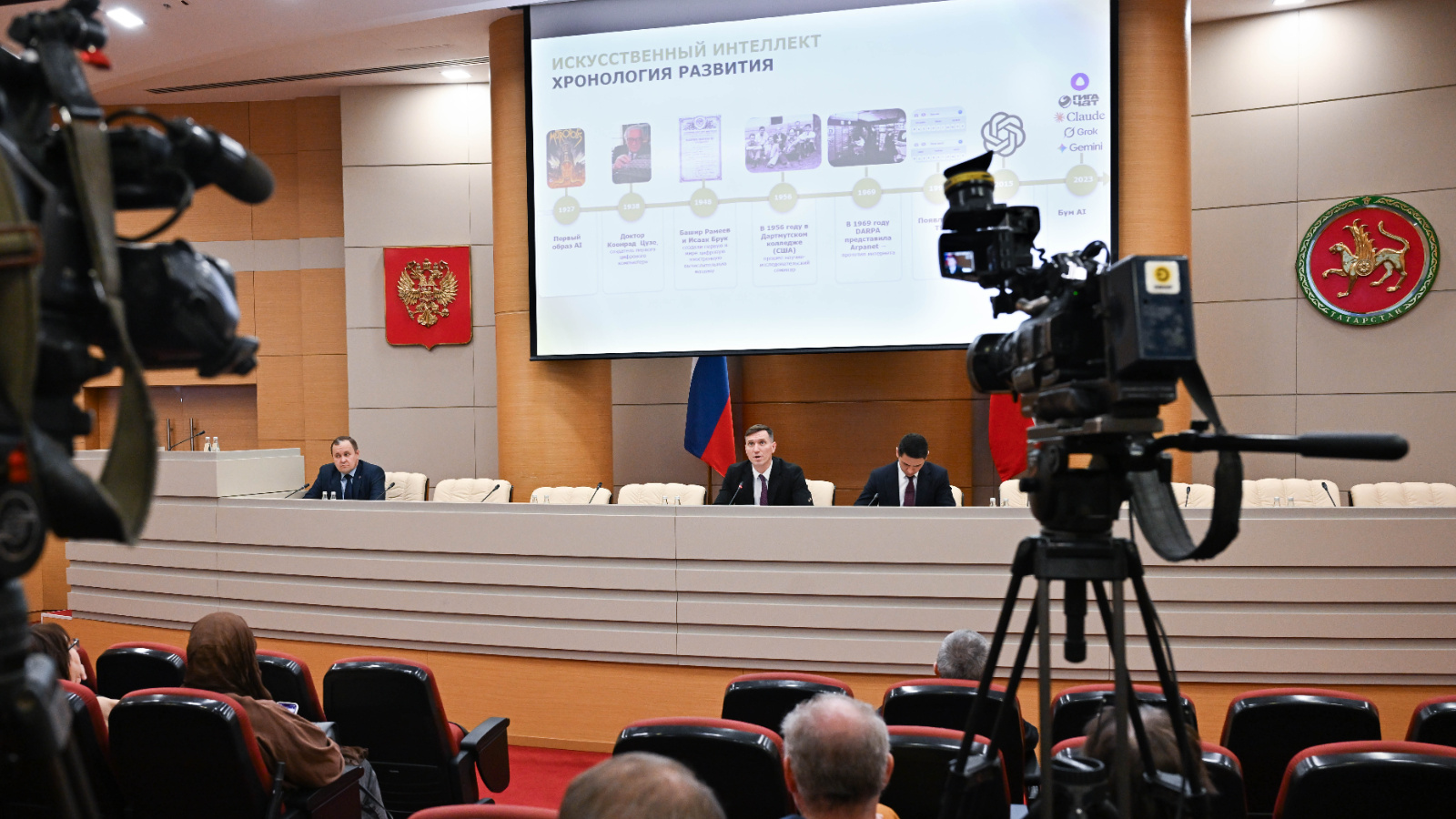
On April 16, speaking at a briefing in the Cabinet of Ministers of the republic, dedicated to the Artificial Intelligence Development Programme for 2026-2030, Tatarstan Minister of Digitalization Ilya Nachvin informed about the key directions of the programme.
The integration of AI into various sectors of the economy is expected to become a primary driver of economic growth. According to research by J’son & Partners Consulting, artificial intelligence significantly enhances workflow efficiency and can save employees up to 12 hours per week.
In 2025, Russia ranked only 30th in the global AI maturity index. During a meeting on AI development, Russian President Vladimir Putin instructed the government and regional authorities to accelerate the deployment of new technologies and establish domestic, sovereign solutions.
Tatarstan has taken proactive steps by launching its own initiative aimed at positioning the region as a leader in AI development and creating its own AI infrastructure. The capabilities of AI, independent of external suppliers will be utilized not only by government agencies but also by healthcare professionals, educators and businesses.
Funding for the project in 2026 will amount to 1 billion roubles from the regional budget, totaling 5 billion roubles over five years.
Key Directions:
Human Resources for AI:
Training specialists starting from school:
From the upcoming academic year, AI clubs will be introduced in 100 engineering-focused schools, reaching over 3,500 children. In grades 5-6, students will learn to work with neural networks by creating simple projects—texts, images, and presentations. By grade 7, students will advance to creating AI agents using the visual constructor n8n.
Annual professional development for teachers:
This program will cover 100% of informatics teachers (623 individuals). Out of these, 239 top teachers will undergo additional training to lead AI clubs in 100 schools. The development of the program is a joint effort by School 21, Kazan Federal University and Innopolis University.
AI training in the region’s colleges:
Courses on AI will be launched in all 35 colleges with IT programs, with an annual enrollment of 1,500 students. Students will work on real-world tasks and case studies provided by local companies. As many as 100 college educators, who will be trained this summer using materials from Yandex, the International Competence Center, Kazan College of Information Technologies and Communications and the Center for Professional Skills Development will conduct the programme.
New grant program "Algarysh–AI":
"Algarysh" is a grant programme initiated by Tatarstan Government for training and internships at Russian and international educational organizations. It is the first regional grant program in Russia, successfully implemented since 2006.
Eligible participants are final-year students or recent graduates living in Tatarstan. The grant covers tuition, accommodation, meals, insurance, travel and a stipend. Recipients are required to complete their diploma, secure employment in Tatarstan and work in their field for at least three years. This initiative aims not only to cultivate a local generation of experts but also to supply regional enterprises with qualified personnel and retain talent within the region.
Infrastructure:
Annual procurement of modern servers for government and business:
This programme is aimed at creating conditions for AI adoption in regional enterprises. Previously, businesses faced high entry costs and a lack of expertise. The republic will provide infrastructure at a dedicated Data Processing Center for testing AI solutions, helping companies to evaluate implementations before making investment decisions.
Fine-tuning global AI models for regional tasks:
Regionally trained AI models based on industry-specific data will be utilized by both the government and businesses. These models will analyze technical documentation, predict equipment failures and recommend optimal solutions.
Sector-Specific AI Projects:
"GosPrompt" AI service (over 3,000 users):
This service will be integrated into each industry of Tatarstan, tailored to its specifics.
Public Services: AI agents will verify uploaded documents and highlight necessary corrections.
Education: AI will assist teachers by generating lesson scenarios, test assignments, grading submissions, etc.
Healthcare: AI agents will monitor prescribed medications, prevent harmful combinations, optimize ambulance routing and analyze CT scans, MRIs, X-rays and mammograms.
Construction: AI will review estimates, invoices, and generate comprehensive reports on projects.
Agriculture: Farmers will be able to consult AI bots for yield forecasts, profit analysis, seeding tips, crop treatments, etc., helping reduce crop losses and prevent issues.
Ecology: "GosPrompt" will detect illegal mineral extraction by analyzing video footage from mining sites.
Annual deployment of 10 AI agents for government agencies:
These agents will streamline staff workflows. In 2026, AI assistants will be introduced to the Ministry of Justice, Civil Registry Office, State Housing Inspection and other sectors.
Science:
Establishment of AI laboratories in partnership with the Academy of Sciences of Tatarstan:
Teams of scientists, engineers, and students will work on solving concrete economic problems. Two labs will be established this year, created with industry partners to facilitate rapid implementation of research into regional industries.
Publishing new scientific findings:
The program will support the dissemination of research at leading scientific conferences and in specialized scientific journals, strengthening the scientific base for AI and translating innovations into practical solutions for Tatarstan's economy.